
Most EdTech brands don’t have a traffic problem.
They have this instead:
People visit → leave → never come back → no enquiry
And when I audit these sites, I usually see the same 3 issues:
- The content doesn’t answer real buying questions
- The site doesn’t build enough trust
- They’re invisible in AI-driven search
So let me walk you through how I’d fix this step by step.
Contents
- 1 1. Fix the “no enquiries” problem first (not traffic)
- 2 2. Build content around real buying questions
- 3 3. Start optimising for AI visibility (this is where most are behind)
- 4 4. Fix your technical foundation (don’t ignore this)
- 5 5. Build trust like a serious brand (this is where deals are won)
- 6 6. Track what actually matters
- 7 7. How this connects to your growth strategy
- 8 Quick note (this is important)
- 9 Final thought
- 10 If you want a real next step
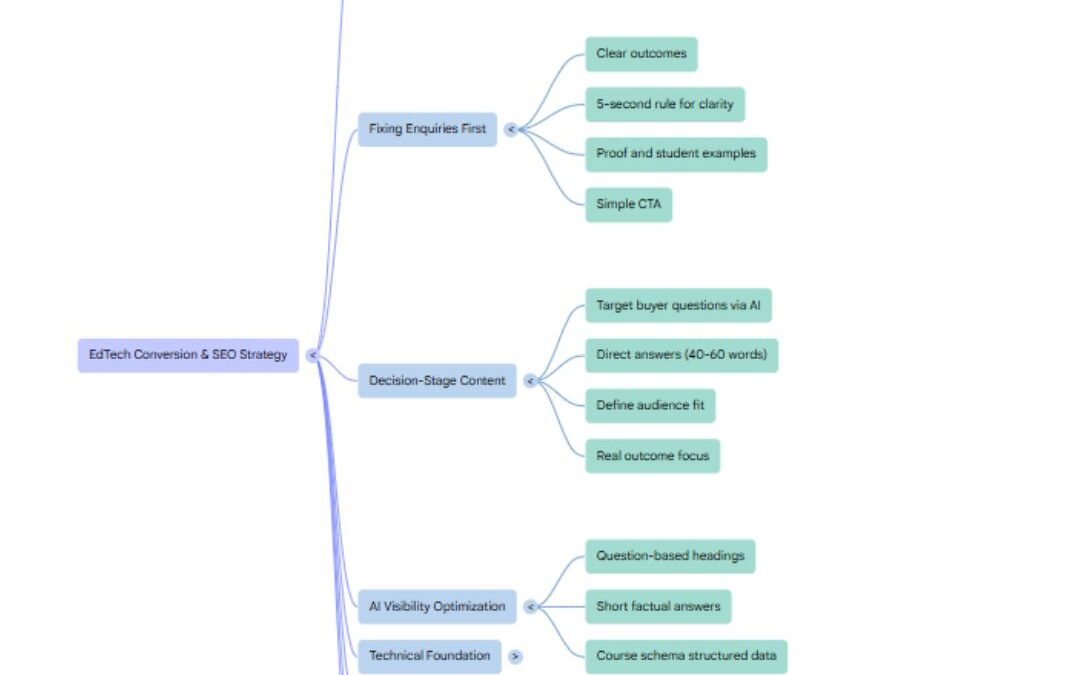
1. Fix the “no enquiries” problem first (not traffic)
Before doing anything with SEO, check this:
Go to your top landing page and ask:
- Does this clearly explain what outcome I’ll get?
- Can a parent/teacher/admin understand this in 5 seconds?
- Is there proof?
If not, that’s your first leak.
What to change (practical)
Instead of this:
“We provide innovative learning solutions”
Rewrite like this:
“Students using this program improved math scores by 32% in 3 months.”
Then add:
- 1 real student example
- 1 clear outcome
- 1 simple CTA
That alone can improve conversions without touching traffic.
2. Build content around real buying questions
Most EdTech blogs are written for keywords.
That’s the mistake.
You should write for decision-stage questions.
How to find these questions
Do this:
- Open ChatGPT
- Type: “What questions do parents ask before choosing an online learning platform?”
You’ll get raw, real queries.
You can also use AI SEO tools to cluster these into topics, but don’t overcomplicate it.
What your content should look like
Each blog should answer one core question.
Example:
“Is an online MBA worth it in 2026?”
Structure:
- Direct answer (40–60 words)
- Who it’s for
- Who it’s NOT for
- Real outcomes
- CTA
This format:
- Gets picked by AI
- Builds trust
- Converts better
3. Start optimising for AI visibility (this is where most are behind)
Right now, your content is probably written like this:
- Long paragraphs
- No clear answers
- No structure
AI can’t use that properly.
Here’s how to fix it
For every important page:
Step 1: Add question-based headings
Example:
- What is this course about?
- Who should take this?
- Is this worth the investment?
Step 2: Answer immediately under each heading
Keep answers:
- Short
- Clear
- Factual
Step 3: Add structured data (basic level)
Use course schema:
- Duration
- Fees
- Level
This helps both search engines and AI understand your content better.
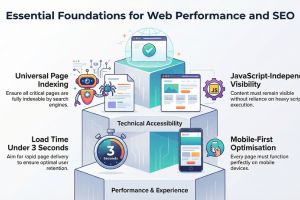
4. Fix your technical foundation (don’t ignore this)
You don’t need advanced SEO here.
Just avoid the common mistakes.
If you’re using modern frameworks
This is important.
If your site is built as a Single Page Application:
- Use server-side rendering
- Or pre-render key pages
Otherwise, Google and AI tools won’t fully read your content.
5. Build trust like a serious brand (this is where deals are won)
In EdTech, trust is everything.
Not branding. Not design.
Trust.
What I would add immediately
- Student success stories (with real data)
- Before vs after
- Specific improvement
- Institutional proof
- Partnerships
- Certifications
- Compliance clarity
- Data privacy
- Safety
One underrated tactic
Create detailed “outcome pages”.
Example:
“How students improved coding skills in 90 days”
These:
- Rank well
- Build trust
- Convert better than generic pages
6. Track what actually matters
Most people track vanity metrics.
That’s why they don’t grow.
Stop focusing only on:
- Clicks
- Rankings
Start tracking:
- Time on page
- Course page visits
- Brochure downloads
- Repeat visits
These show real intent.
7. How this connects to your growth strategy
Let’s make this practical.
If I was building this today:
Month 1:
- Fix landing page messaging
- Add 3 strong proof elements
Month 2:
- Publish 5 decision-stage blogs
- Structure them for AI answers
Month 3:
- Add student stories + schema
- Improve internal linking
Quick note (this is important)
I’ve seen this across markets.
Whether it’s:
- an EdTech startup
- a SaaS brand
- or even someone offering digital marketing services in Chennai
The pattern is the same.
People focus on traffic first.
But the real growth comes from:
Fixing trust + clarity + intent
Even a digital marketing freelancer in Chennai or a digital marketing freelancer in Bangalore who understands this can outperform bigger agencies.
Because they focus on what actually converts.
Final thought
You don’t need more content.
You need better answers.
You don’t need more traffic.
You need more trust.
Fix those two, and everything else starts compounding.
If you want a real next step
Do this today:
Pick one page on your site and improve:
- Clarity
- Proof
- Direct answers
Don’t touch anything else.
Just that.
You’ll start seeing the difference.
