

If you’re still reporting page-one rankings to your leadership team, you’ve probably felt this tension already. Search is no longer just a list of blue links. Today, AI systems read, summarise, and decide which content deserves to be quoted as the final answer. Instead of ten options, users increasingly see one synthesized response. That’s the paradigm shift.
Recent industry data shows that over sixty percent of search results now include AI Overviews, up sharply from last year. Even more telling, AI-driven referrals have grown more than three hundred percent year over year [Google Search Central]. This means people are still discovering brands but not always by clicking websites.
For marketers, especially those explaining strategy to founders or CMOs, this requires a mindset shift. Think of it this way:
- Old SEO = Best Seller (loud, popular, clickable)
- New AI search = Librarian (trusted, quotable, referenced)
This guide breaks down how seo for ai search actually works, how it differs from traditional SEO, and how you can position your content to become the answer AI systems choose.
Contents
- 1 What Is GEO and Why It’s Not Just “Better SEO”
- 2 The Architectural Blueprint: Content Built for Machine Parsing
- 3 Beyond Keywords: Building Authority and Brand Adjacency
- 4 Technical Foundations: Helping Bots Identify Relevance
- 5 The Power of Multi-Modal Content
- 6 Measuring Your GEO Performance
- 7 Conclusion:
- 7.1 FAQs
- 7.2 Is SEO possible with AI?
- 7.3 What is the 30 percent rule for AI?
- 7.4 What is SEO for AI search called?
- 7.5 Does SEO detect AI content?
- 7.6 How to rank in AI search results?
- 7.7 SEO vs AI search: what is the difference?
- 7.8 Are traditional SEO principles still useful?
- 7.9 Can small websites rank in AI search?
What Is GEO and Why It’s Not Just “Better SEO”
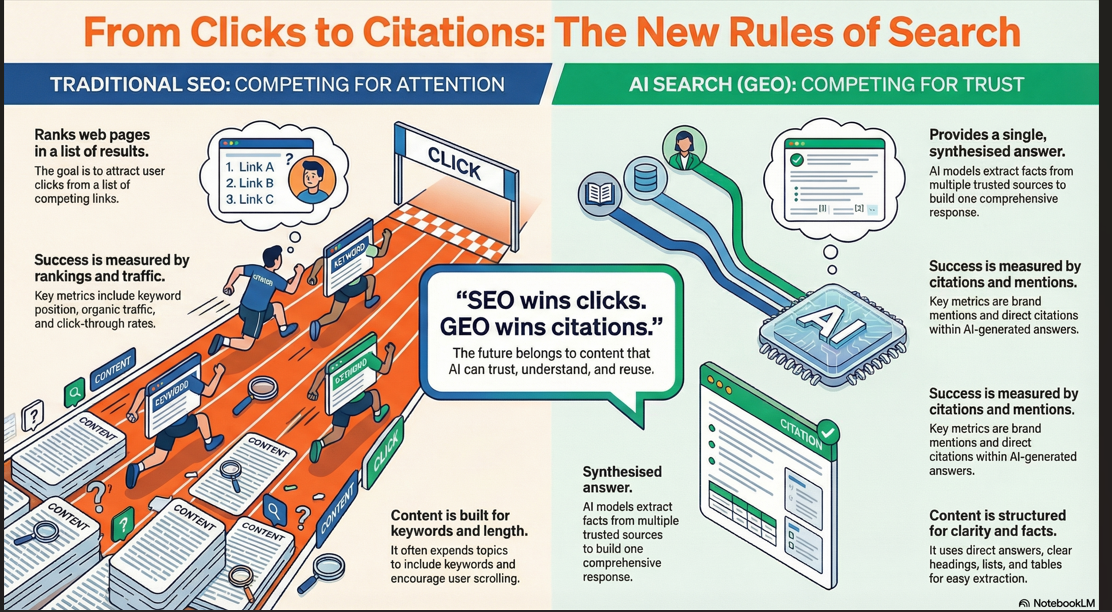
Generative Engine Optimisation (GEO) is the practice of optimising content so it is understood, trusted, and cited by AI-powered search systems not just ranked in traditional results.
Traditional SEO focuses on
- Crawling
- Indexing
- Ranking
GEO focuses on
- Inclusion
- Citation
- Contextual relevance
- Instead of asking, “Can I rank number one?”, GEO asks: “Will an AI model quote me when answering this question?”
The Remix Reality of AI Search
AI systems don’t simply surface one article. They:
- Ingest multiple trusted sources
- Extract key facts
- Remix those insights into a single response
Key Differences: Targets and Metrics
Targets
–>SEO targets search engines
–>GEO targets models like ChatGPT, Perplexity, and Gemini
Metrics
–>SEO tracks clicks, rankings, bounce rate
–>GEO tracks citations, brand mentions, sentiment, and impression presence
The Architectural Blueprint: Content Built for Machine Parsing
To win at seo for ai search engines, you must understand how AI reads.
AI doesn’t skim like a human. It parses content, breaking pages into structured, modular components to assess relevance.
The Inverted Pyramid: Give the Answer First
Each section should start with a one-to-two sentence direct answer.
This satisfies:
- AI summary engines that need fast clarity
- Humans who want quick confirmation
Then, expand with supporting context for deeper readers.
Structure as Authority: Lists, Tables, and Q&A
In high-trust topics, structured content dominates AI citations.
Why?
- Lists are extractable
- Tables are comparable
- Q&A mirrors natural search language
Direct question-and-answer formatting often gets lifted word for word into AI responses making it essential for seo for ai search results.
Solving the Depth vs Conciseness Conflict
You don’t need shorter content.
You need modular content:
- Long-form authority pages
- With snippable sub-sections
- Each capable of standing alone
This is how you balance depth without losing AI visibility
Beyond Keywords: Building Authority and Brand Adjacency
Keywords still matter—but authority matters more.
AI systems evaluate E-E-A-T signals:
- Experience
- Expertise
- Authoritativeness
- Trustworthiness
Brand Adjacency and Semantic Precision
Industry experts often say: you don’t win by shouting you win by being mentioned in the right conversations.
That means:
- Clear, factual language
- Precise data points
- Consistent association with your topic
“Forty-two decibel noise output” beats “quiet and innovative” every time.
This principle directly impacts seo principles ai search systems rely on.
The B2B Advantage: AI Agents Are Deciding for Users
In B2B, AI is increasingly acting as an agent, filtering vendors before humans even see them.
If your brand lacks authority signals, you’re filtered out before the funnel begins long before your digital marketing funnel has a chance to work.
Establishing Human Authority Signals
AI looks for:
- Real author bios
- Verifiable credentials
- External mentions
- Consistent expertise across platforms
This is where personal brands, consultants, and specialists like a digital marketing freelancer in chennai or a digital marketing services in chennai can outperform large but generic sites.
Technical Foundations: Helping Bots Identify Relevance
Great content fails if AI can’t interpret it.
Schema Markup: The Rosetta Stone for AI
Schema tells machines what your content means.
Must-use schemas:
- FAQPage
- HowTo
- Product
Well-implemented schema dramatically improves seo for ai search engines by removing ambiguity.
Accessibility and Indexation
Common mistakes that kill AI visibility:
- Blocking OpenAI, Bing, or Perplexity bots in robots.txt
- Hiding content inside tabs or accordions that aren’t rendered
- Heavy JavaScript without server-side rendering
If AI can’t see it, it can’t cite it.
The Power of Multi-Modal Content
Text alone is no longer enough.
Charts, Graphs, and Visual Anchors
Answer engines like Perplexity often favour:
- Charts
- Diagrams
- Visual summaries
They compress complex information quickly and provide visual anchoring .
Video Citations and YouTube
Embedding YouTube videos increases citation likelihood, especially for:
- Tutorials
- Walkthroughs
- “How-to” searches
This is a strong complement to AI SEO Tools and modern On Page SEO Techniques.
Measuring Your GEO Performance
You can’t optimise what you don’t measure.
Tracking AI Referral Traffic
In analytics, isolate traffic from:
- chatgpt.com
- perplexity.ai
- gemini.google.com
This is the baseline for evaluating seo vs ai search performance.
Monitoring Brand Mentions and Sentiment
Key metrics to watch:
- Citation frequency
- Share of Voice
- Sentiment accuracy
These indicators matter more than raw clicks.
Correcting AI Hallucinations
When AI gets facts wrong:
- Update authoritative pages
- Reinforce schema
- Strengthen external citations
Consistency is how you correct misinformation over time.
Conclusion:
AI systems tend to re-cite the same trusted sources repeatedly. This creates a snowball effect the closer you are to the top, the harder you are to displace. That’s the real advantage of mastering seo for ai search early.
In this new librarian-driven era of discovery, visibility doesn’t go to the loudest voice. It goes to the most quotable one.
FAQs
Is SEO possible with AI?
Yes. SEO still works, but it now focuses on helping AI systems understand and cite your content, not just rank it in search results.
What is the 30 percent rule for AI?
It means AI-generated content should be edited with human insights, examples, and experience to improve trust and accuracy.
What is SEO for AI search called?
It is called Generative Engine Optimisation (GEO). It helps your content appear in AI-generated answers instead of only search listings.
Does SEO detect AI content?
No. Search engines do not penalise AI content if it is useful, accurate, and written for humans.
How to rank in AI search results?
Answer questions clearly, use structured formats like lists and FAQs, and build topical authority so AI trusts your content.
SEO vs AI search: what is the difference?
SEO focuses on rankings and clicks. AI search focuses on giving one trusted answer using cited sources.
Are traditional SEO principles still useful?
Yes. Technical SEO, content quality, and internal linking still matter, but clarity and expertise matter more in AI search.
Can small websites rank in AI search?
Yes. AI often prefers clear, expert content, which gives small but focused websites a strong advantage.
